
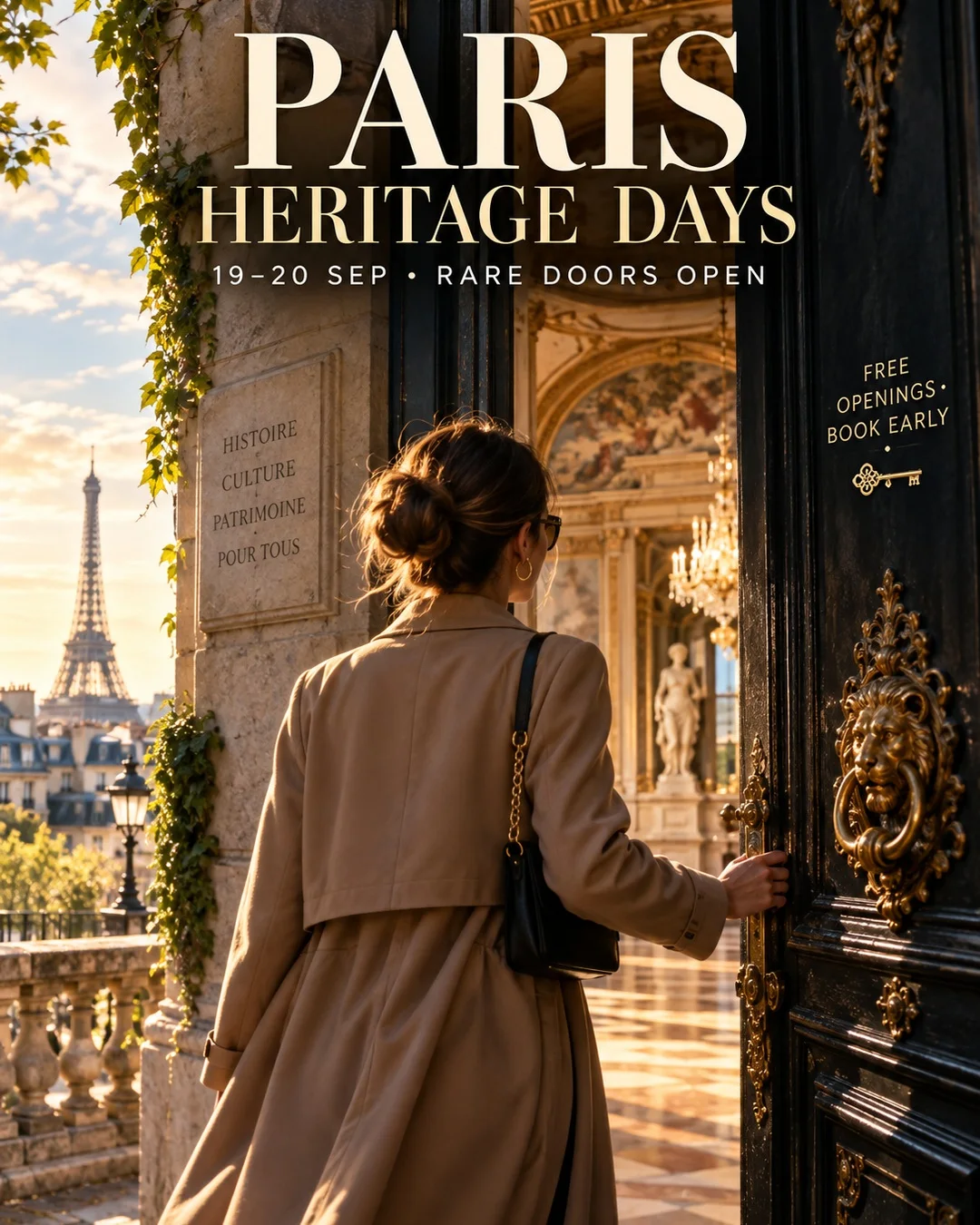
Paris’s European Heritage Days return on Saturday 19 and Sunday 20 September 2026, turning one weekend into a rare chance to enter buildings, archives, workshops and institutional spaces that are normally closed or difficult to visit. The event is free across a large part of the programme, but the most sought-after visits are often reservation-only — and Paris City Hall says a number of events were already full after bookings opened on 9 September.
- Dates: Saturday 19 and Sunday 20 September 2026
- 43rd edition of the European Heritage Days
- Many events are free, but some require advance booking
- Paris City Hall opened registrations on 9 September and warned that some visits filled quickly
- Special access ranges from museums and historic buildings to government sites, restoration spaces and behind-the-scenes areas
- When
- 19–20 September 2026
- Cost
- Many events are free
- Big catch
- Popular sites may be reservation-only or already full
- Best strategy
- Book one or two high-priority visits, then build the rest of the day around walk-in options nearby
Why this weekend is genuinely different
European Heritage Days are not simply a citywide museum discount. The attraction is access. Government buildings, archives, historic interiors, technical spaces, restoration workshops and other places that are usually closed to casual visitors open for tours, demonstrations or temporary programmes.
Paris City Hall describes the weekend as a chance to enter exceptional buildings and discover religious architecture, restoration projects, historic sites and places of commemoration. Paris je t’aime likewise highlights one-off openings and unusual venues across Paris and Greater Paris. For travellers who enjoy architecture, civic history or the workings behind major monuments, this can be one of the most interesting weekends of the year.
The booking problem: free does not mean spontaneous
The biggest mistake is assuming that “free” means you can simply walk into every headline site. Paris City Hall says bookings for its own cultural-affairs visits and Hôtel de Ville programme opened on 9 September, and that a number of events were already fully booked.
If there is one normally inaccessible place you care about, reserve it first. Then choose nearby walk-in or lower-pressure venues as your backup. Trying to cross Paris between three tightly timed reservations is a good way to spend Heritage Days underground on the Metro instead of inside heritage sites.
Examples of what is open in 2026
The 2026 programme ranges widely. The Institut du Monde Arabe is opening its museum, exhibitions, talks, workshops and activities across the weekend, with free access and reservation recommended. The Musée des Arts et Métiers is offering behind-the-scenes access, including exceptional visits to reserve spaces normally closed to visitors.
Musée Carnavalet has free activities across both days, including guided introductions to essential works, unusual objects and curator presentations. The Petit Palais is also running free programmes in its permanent collections and garden, with activities focused on preservation and the work required to protect heritage.
Some of the most interesting visits are not museums
The Ministry for Europe and Foreign Affairs is opening the Hôtel du Ministre on Quai d’Orsay, free with reservation, alongside other ministry heritage sites. Paris City Hall is also promoting special urban and architectural experiences, including a Seine cruise focused on the UNESCO-listed riverbanks.
That mix is the real appeal: Heritage Days reward visitors who are willing to look beyond the usual Louvre–Eiffel Tower checklist. A diplomatic building, a conservation store, an archive or a restoration workshop may be far harder to visit on an ordinary Paris trip than a famous museum.
How I would plan the weekend as a visitor
Pick one reservation-only “anchor” that would normally be inaccessible. Keep the rest of the day geographically tight. If your anchor is central, combine it with nearby museums or walk-in heritage activities rather than bouncing from the 7th arrondissement to the 19th and back again.
For Saturday, prioritise the hardest-to-access institutional visit. For Sunday, build a looser day around museums, churches, neighbourhood architecture and programmes that accept walk-ins or on-site registration. This gives you a good weekend even if a desired booking has already disappeared.
Expect queues even when no reservation is required
Free public access to unusual buildings attracts Parisians as well as tourists. If a site is famous, visually striking or rarely open, arrive early and allow time for security screening. Keep a second nearby option in mind so one long queue does not consume half your day.
Also re-check the event page the night before. Heritage programmes can use timed entry, limited capacity, last-minute releases or cancellation places. Paris City Hall notes that places can sometimes reappear after cancellations, so a sold-out listing is worth checking again rather than treating it as permanently closed.
- Must-see
- Book it now if reservations are still available
- Second choice
- Pick a walk-in site within the same part of Paris
- Transport
- Group visits by neighbourhood rather than chasing scattered free entries
- Same-day check
- Confirm times, access and reservation status before leaving
Official sources checked
- Ville de Paris — 2026 European Heritage Days programme
- Paris je t’aime — European Heritage Days 2026 visitor guide
- France Diplomatie — Quai d’Orsay openings for Heritage Days
- Petit Palais — 2026 Heritage Days programme
Cheers, Carpe Diem & Get Behind a Door That’s Usually Locked! 🔑⏳🇫🇷
TATS Man
Your Paris rare-opening planner